If you have called around for tree work in Simcoe County, you have probably noticed that companies use a range of titles — tree service, tree surgeon, arborist, tree cutter, tree guy. These terms are not interchangeable, and the differences matter more than most homeowners realize. Choosing the wrong person to work on your trees can result in permanent damage, voided insurance claims, and costs that far exceed what proper care would have required in the first place.
What an Arborist Actually Is
An arborist is a professional who specializes in the cultivation, management, and study of individual trees, shrubs, vines, and other perennial woody plants. While a logger focuses on harvesting timber and a landscaper focuses on overall yard design, an arborist's specific focus is the long-term health, structure, and safety of trees. The distinction matters because tree care requires deep knowledge of biology, biomechanics, pathology, and soil science — disciplines that general contractors and landscapers are not trained in.A qualified arborist has demonstrated competency through formal education, field experience, or professional certification. The most widely recognized credential in North America is the ISA Certified Arborist designation, administered by the International Society of Arboriculture. To earn it, candidates must pass a comprehensive exam covering tree biology, diagnosis, pruning, soil management, tree risk assessment, and safety. They must also complete 30 continuing education units every three years to maintain the credential.
The Scale of Professional Arborist Certification
The ISA is the global authority on arborist certification. As of 2024, ISA has certified more than 23,000 arborists across more than 40 countries worldwide — a relatively small number when you consider how many properties have mature trees requiring professional care. In Ontario specifically, there are approximately 800 ISA Certified Arborists serving a province with over 5.5 million residential properties. That ratio underscores how meaningful the credential is and why homeowners should verify credentials before hiring.Beyond the base ISA Certified Arborist designation, there are advanced credentials: ISA Board Certified Master Arborist (the highest level, requiring additional testing and experience), ISA Tree Risk Assessment Qualification (TRAQ, specialized in evaluating tree hazards), and the Tree Care Industry Association (TCIA) accreditation, which certifies entire companies — not just individuals — against safety, training, and business practice standards.
What a Qualified Arborist Does in Simcoe County
The scope of arborist work extends far beyond cutting. In Simcoe County, where property owners manage species ranging from sugar maples and red oaks to white pines and Eastern white cedars, a qualified arborist provides services that no general contractor can replicate:Tree health assessment and diagnosis: Identifying diseases like oak wilt, cytospora canker on spruce, apple scab on ornamental crabapples, and pest infestations like emerald ash borer (EAB) — all of which are active threats in our region. Accurate diagnosis determines whether a tree can be treated and saved or must be removed.
Structural pruning and crown management: Prescribing and performing pruning that follows ANSI A300 standards — the industry benchmark. This includes crown cleaning (removing dead and hazardous wood), crown thinning (improving air circulation and reducing wind load), crown raising (increasing clearance), and crown reduction (reducing overall height and spread). Each pruning type has specific applications depending on the tree's species, condition, and location.
Tree risk assessment: Evaluating whether a tree poses a hazard to people or property. This is critical in Simcoe County, where Georgian Bay lake-effect storms, ice storms, and high winds regularly test the structural limits of mature trees. A qualified arborist uses systematic methods — visual assessment, sounding, and sometimes resistograph or tomograph testing — to evaluate internal decay that is invisible from the outside.
Tree preservation during construction: When homeowners build additions, install pools, or develop lots in areas like Tiny Township, Penetanguishene, or the Barrie waterfront, qualified arborists create tree preservation plans that protect root zones and prevent construction damage to trees intended to remain.
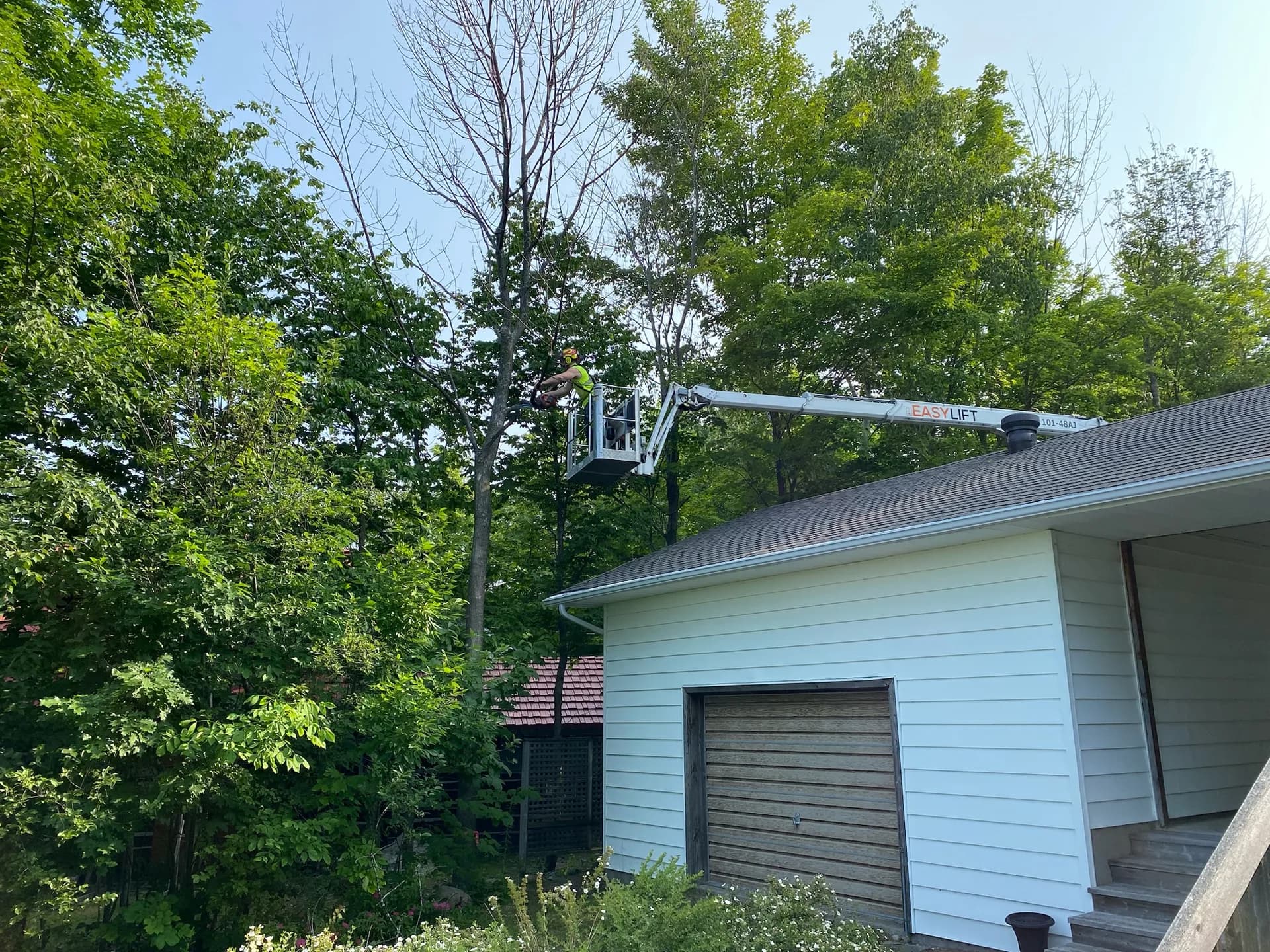
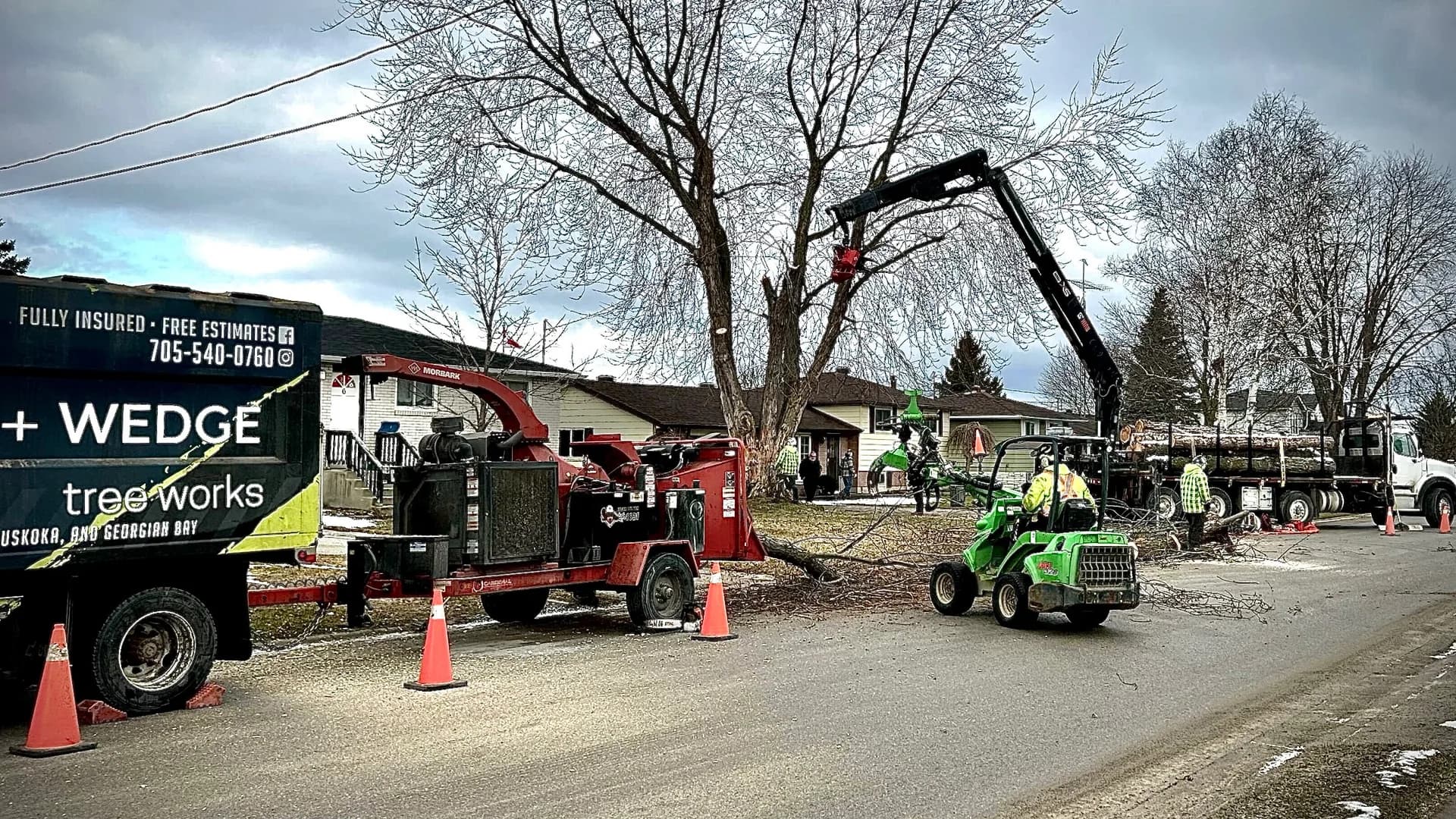
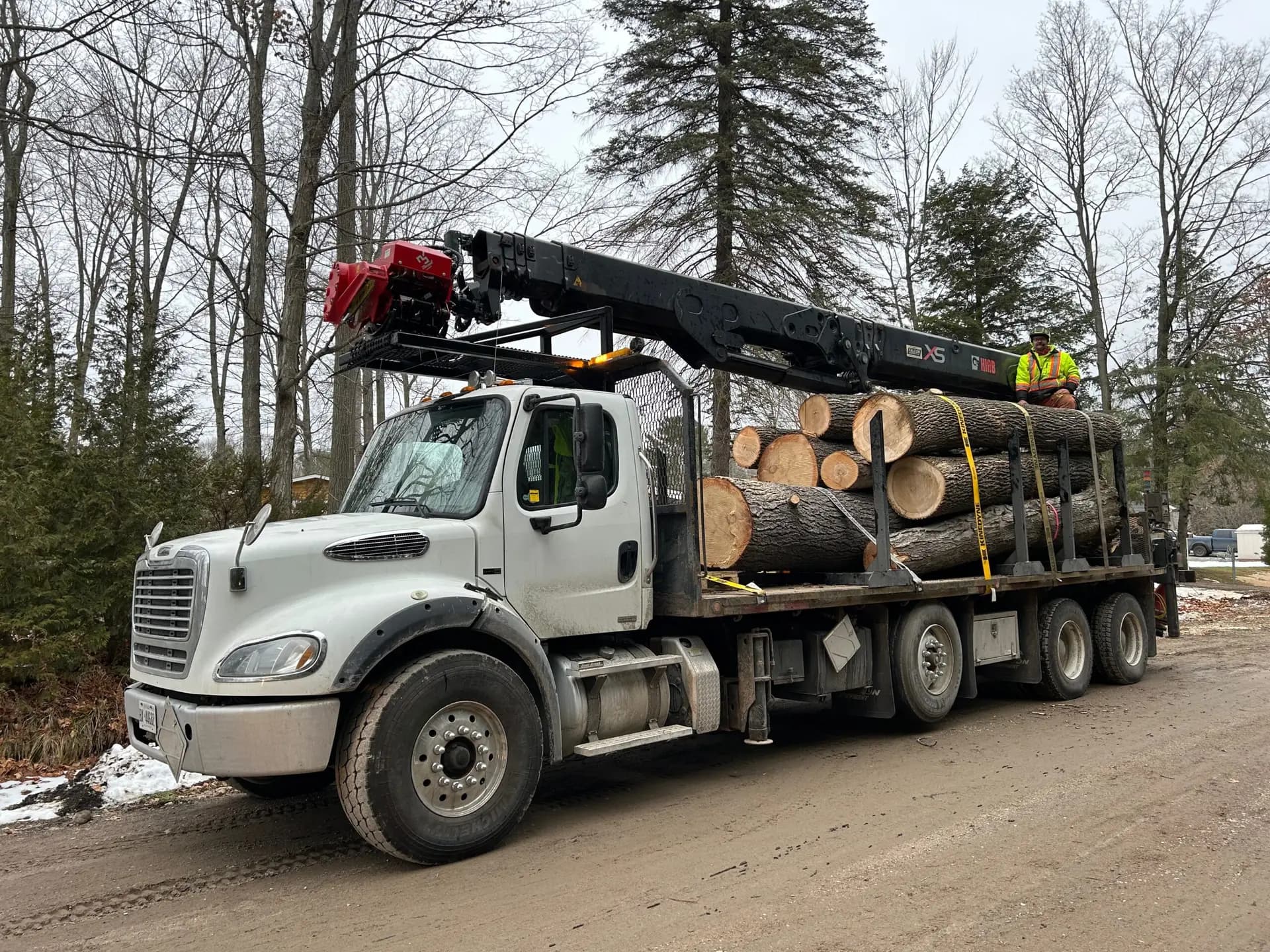
Removal planning and execution: When a tree cannot be saved, an arborist plans the safest and most efficient removal method. This may involve directional felling, sectional dismantling with ropes and rigging, or crane-assisted removal for large trees near structures. The difference between an arborist-planned removal and an ad hoc takedown is the difference between a controlled operation and a gamble.
Written reports and documentation: Arborists provide written assessments for insurance claims (storm damage, liability), municipal permit applications (many Simcoe County municipalities require arborist reports before issuing tree removal permits), property transactions, and neighbour disputes involving boundary trees.
Why Qualified Arborists Produce Better Outcomes
Trees under professional arborist care live significantly longer than trees that receive no professional attention. The ISA cites data showing professionally managed trees can live three to seven times longer than neglected trees. The difference compounds over time: a tree that is properly pruned in its first decade develops stronger branch structure, better compartmentalization of wounds, and greater resistance to storm damage and disease throughout its life.In Simcoe County specifically, the consequences of hiring unqualified workers are visible throughout the region. Drive through any established neighbourhood in Barrie, Midland, or Orillia and you will see the results of topping — the indiscriminate cutting of large branches to stubs. Topped trees develop dense clusters of weakly attached regrowth (called watersprouts) that are far more likely to fail in storms than the original branches. A topped tree is structurally worse off than before it was touched, and the homeowner has paid money to make their tree more dangerous.
Other common damage from unqualified work includes flush cuts (cutting too close to the trunk, destroying the branch collar that the tree needs to seal the wound), lion's tailing (stripping all interior branches, leaving foliage only at branch tips and making the tree structurally unstable), and over-pruning (removing more than 25% of live canopy, putting the tree into severe stress).
The Simcoe County Context: Why Local Knowledge Matters
An arborist working in Simcoe County faces conditions that are distinct from Toronto, Ottawa, or southwestern Ontario. Our Zone 5b climate, with winter lows regularly reaching –25°C to –30°C, creates specific stresses on trees. Georgian Bay's lake-effect weather produces rapid, heavy snowfall and ice accumulation that inland areas do not experience. The clay-heavy soils common in Midland, Penetanguishene, and coastal Tiny Township behave differently than the sandy loams of inland Oro-Medonte or the rocky Canadian Shield soils north of Orillia.A qualified arborist familiar with Simcoe County understands which species thrive here and which struggle. They know that white spruce is more resistant to cytospora canker than blue spruce (a non-native species often planted ornamentally that suffers badly in our climate). They know that silver maples — common in older Barrie neighbourhoods — have inherently weak branch unions and need more frequent structural assessment than sugar maples. They know that EAB has killed the majority of untreated ash trees in the region and can advise on whether treatment is viable for a specific tree or whether removal is the only practical option.
At Axe & Wedge Tree Works, we have served 4,418 clients across Simcoe County since 2017 — from Collingwood and Wasaga Beach in the west to Orillia in the east, and from Barrie in the south to Penetanguishene and Tiny Township along the Georgian Bay coast. That volume of local work means our qualified arborists have hands-on experience with every common species, soil type, and weather condition in the region. We carry $5M in commercial liability insurance and full WSIB coverage, and we are happy to provide all documentation before any work begins.
Red Flags: How to Spot an Unqualified Tree Worker
Knowing what to avoid is as important as knowing what to look for. Be wary of any tree worker who goes door to door soliciting work (especially after storms), cannot provide proof of insurance and WSIB coverage, recommends topping as a pruning method, quotes a price without inspecting the tree in person, does not have a business address or a verifiable online presence, asks for full payment before work begins, or uses the term "licensed arborist" — Ontario has no arborist licensing system, so this is a meaningless claim.Every year, Simcoe County homeowners lose thousands of dollars to unqualified operators who damage trees, leave cleanup incomplete, or cause property damage with no insurance to cover it. Taking 15 minutes to verify credentials before hiring can save you significant money and protect your trees.
For a free assessment from qualified arborists who have earned 598 five-star Google reviews, call Axe & Wedge Tree Works at 705-540-0760. We serve all of Simcoe County — Barrie, Midland, Penetanguishene, Orillia, Collingwood, Wasaga Beach, Tiny Township, Tay, Springwater, Oro-Medonte, and surrounding communities.