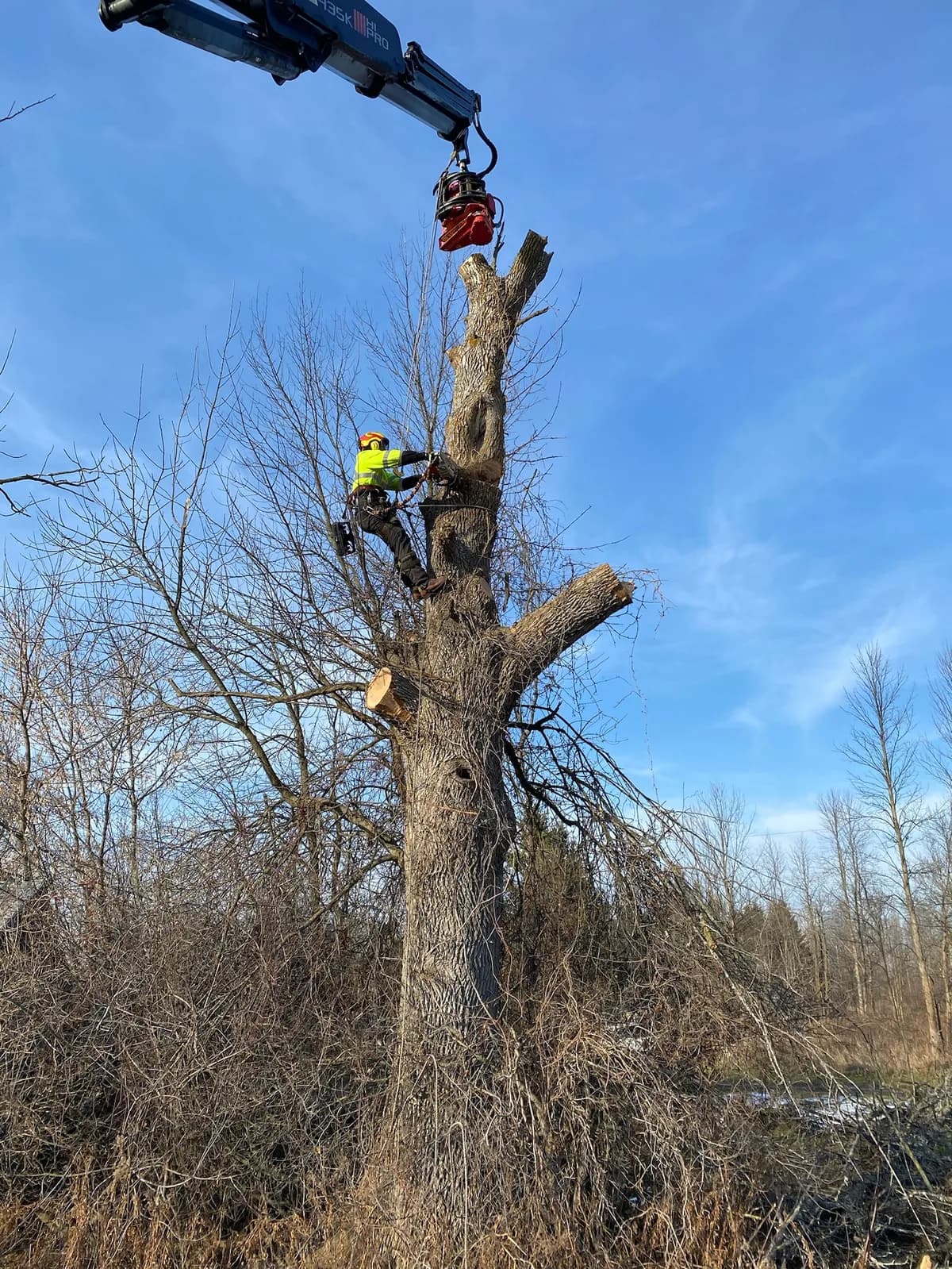
As arborists, our preference is always to preserve a tree if it can be done safely. Mature trees provide shade, privacy, and real property value — studies show a single mature tree can add $1,000–$10,000 to a home's assessed value (USDA Forest Service, 2018). But some situations leave no viable alternative to removal. Here are seven signs that a tree needs to come down.
According to the Insurance Bureau of Canada, falling trees and branches cause over $1 billion in property damage annually in Canada. The ISA estimates that more than 80% of tree failures show visible warning signs beforehand — making early identification critical.
1. The Crown Is Mostly Dead
A tree that has lost more than 50% of its canopy — whether to disease, drought, pest damage, or decline — is unlikely to recover. Half-dead trees are structurally unpredictable: the dead portions become brittle and prone to sudden failure, while the living portions continue to grow and add weight and wind resistance. If more than half your tree's crown is dead or dying, removal is typically the right call.
2. There Is Significant Hollow or Decay in the Trunk
Some hollowing is manageable, but when internal decay has compromised a significant portion of the trunk's cross-section, the structural risk becomes unacceptable. Research from the ISA indicates that a tree with internal decay extending beyond one-third of the trunk diameter has a dramatically elevated failure risk. A qualified arborist can assess this using probes or resistograph testing.
3. The Tree Has Developed a Dangerous Lean
A sudden lean — especially one accompanied by soil heaving on one side — indicates root failure. Unlike a natural gradual lean that a tree has grown with over years, a sudden lean can precede rapid and complete failure. Trees with a lean exceeding 15 degrees from vertical and evidence of root plate lifting should be treated as an emergency situation.
4. Major Surface Roots Are Damaged or Severed
Construction, trenching, grading, and soil compaction can destroy critical portions of a tree's root system. According to the ISA, 50% or more of a tree's root system can be destroyed before symptoms appear above ground. A tree may look healthy for years after major root damage before suddenly failing. If significant root damage has occurred, an arborist assessment is essential.
5. The Tree Has Significant Storm Damage
Not all storm damage is fatal — a tree that loses a major branch but retains most of its crown and structural integrity can often recover. But when the main trunk is split, bark is stripped down the trunk, or more than half the crown is gone, removal is usually the safest and most practical option.
6. The Tree Is Infected with a Lethal Disease
Some tree diseases are fatal and untreatable once established. Emerald Ash Borer — which has destroyed an estimated 100 million ash trees across North America (Canadian Forest Service, 2023) — Dutch Elm Disease, and advanced Oak Wilt are examples where, once significantly affected, removal is the only viable option. Prompt removal also reduces the risk of spreading to neighbouring trees.
7. The Tree Is Threatening a Structure or Utility Line
A structurally sound tree growing into a building, damaging foundations, or in contact with power lines may need removal even if otherwise healthy. Trees within striking distance of a structure pose 3x the liability risk of open-grown trees (ISA Risk Assessment Framework). Call your utility provider immediately if a tree is in contact with power lines — never attempt to cut it yourself.