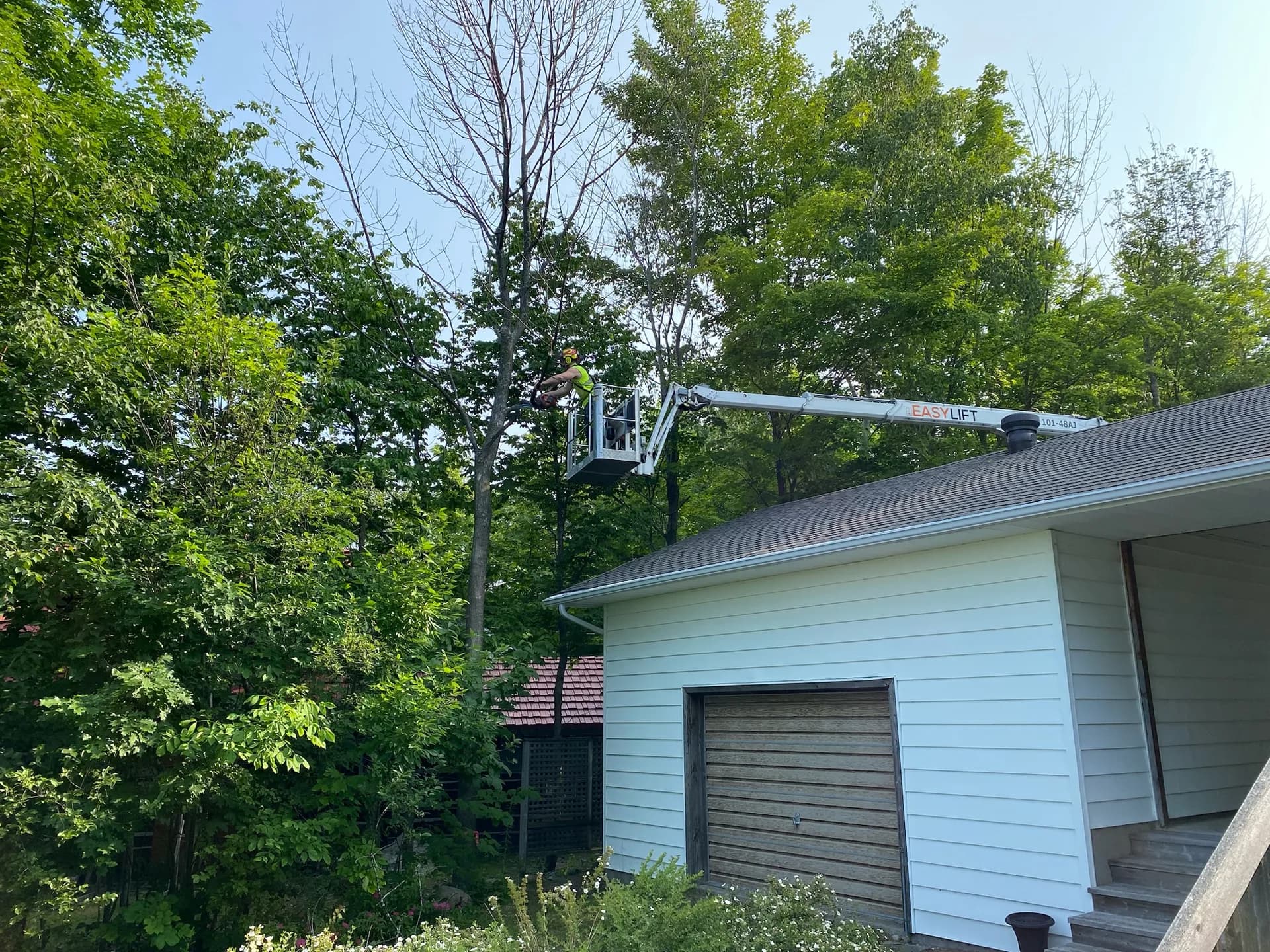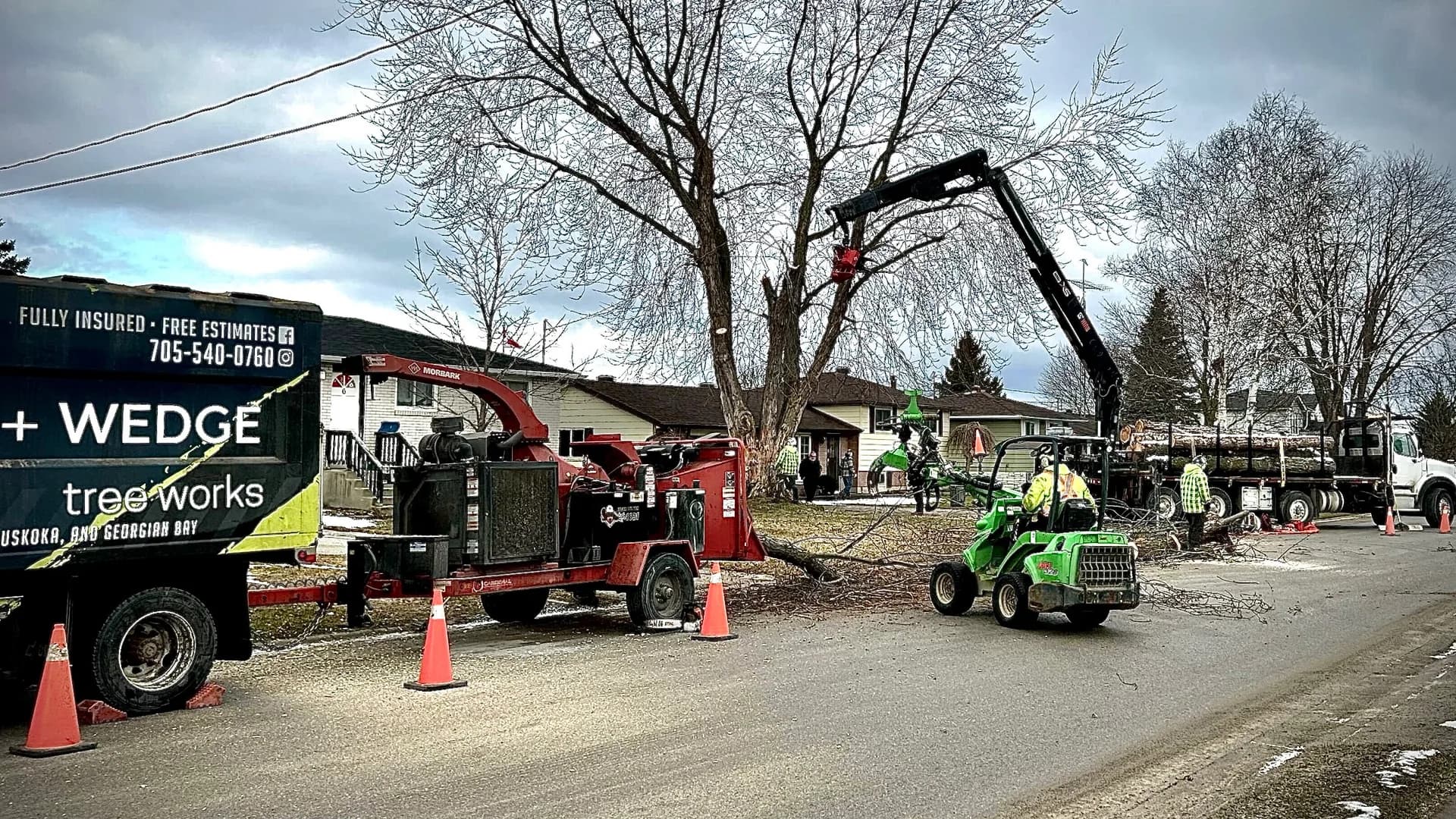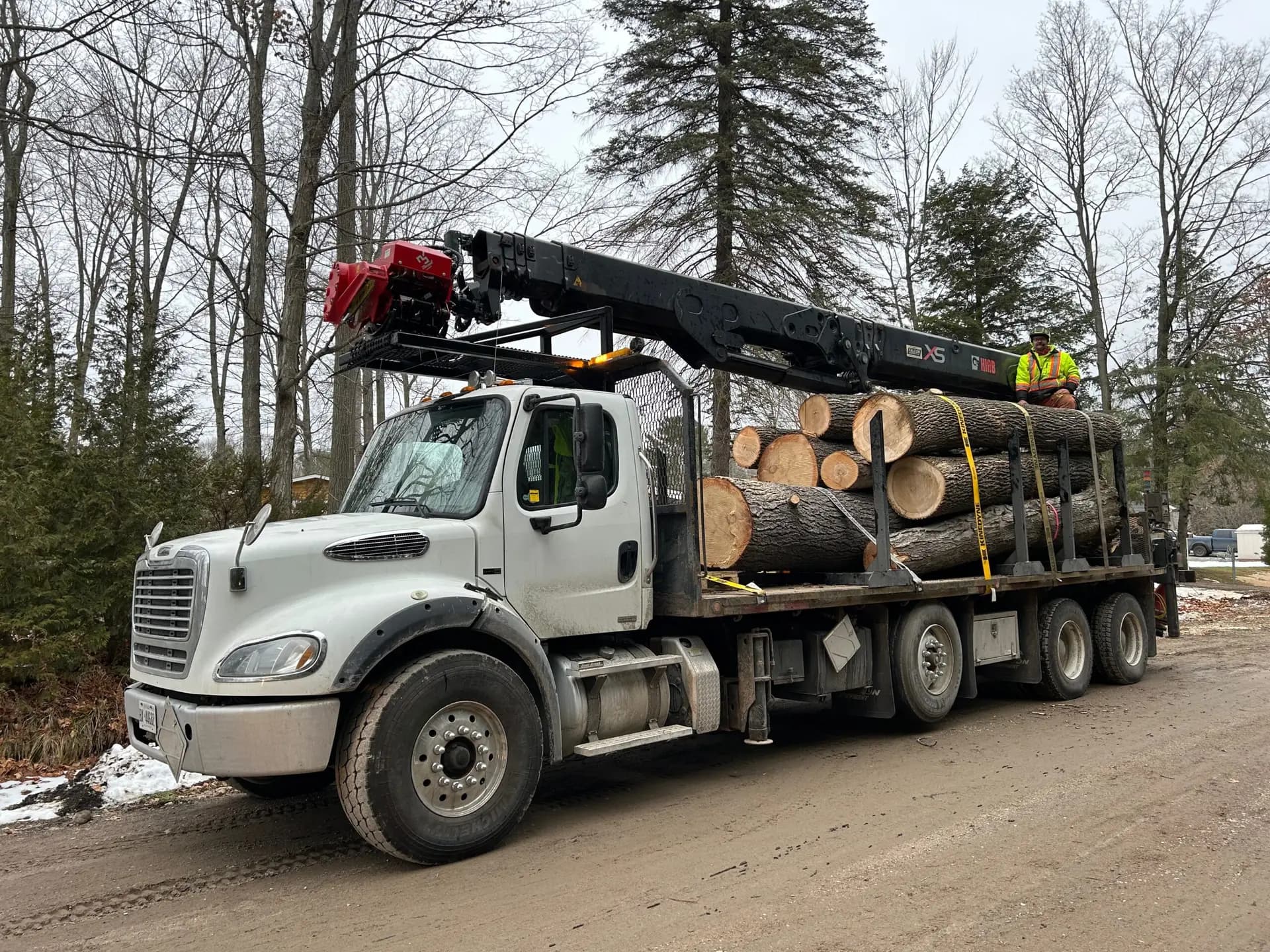
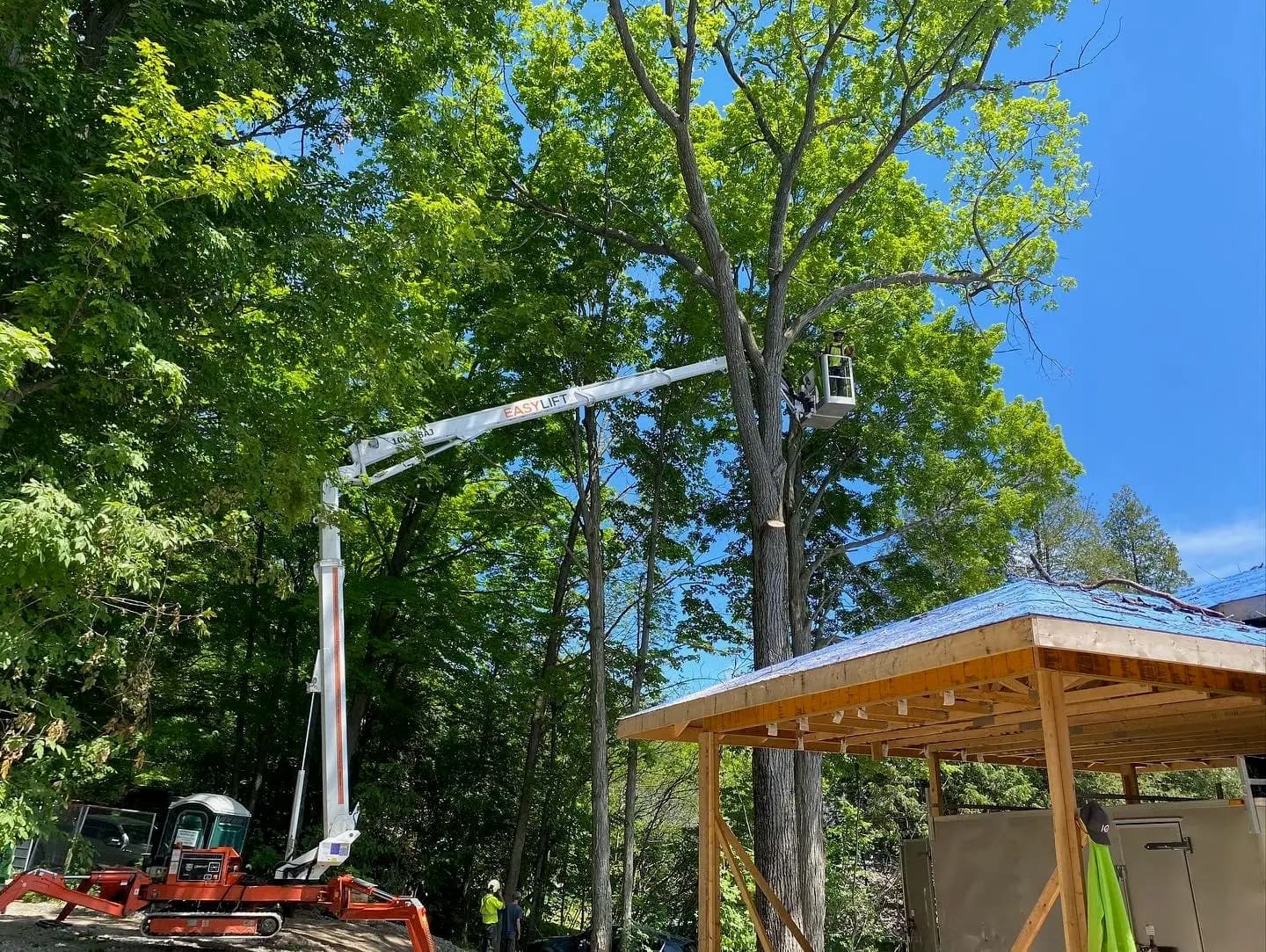
Tree pruning is the selective removal of branches to improve a tree's health, structure, safety, and appearance. It is the single most impactful maintenance practice a homeowner can invest in — yet it is also the most commonly neglected. In Simcoe County, where mature maples, oaks, ash, and white pines surround thousands of residential properties, regular pruning is not optional if you want to protect your home and preserve your landscape. At Axe & Wedge Tree Works, we have completed over 2,449 jobs since 2017 and served 4,418 clients across the region. A large share of the emergency calls we receive could have been prevented with routine pruning in prior years.
1. Safety: Preventing Branch Failures Before They Cause Damage
Dead and structurally compromised branches are the leading cause of tree-related property damage in Simcoe County. Georgian Bay lake-effect storms routinely dump 20–40 cm of heavy, wet snow in a single event, and ice storms — like the one that hit southern Simcoe County in April 2023 — can coat branches with 10–15 mm of radial ice, more than doubling their weight. Branches with decay, cracks, or included bark unions (where two stems trap bark between them) are the first to fail under these loads.Regular pruning removes these weak points before they become hazards. A crown clean every 3–5 years identifies and eliminates deadwood, hangers (partially detached branches caught in the canopy), and structurally compromised limbs. For properties along the Georgian Bay shoreline — Tiny Township, Penetanguishene, and Midland — where wind exposure is higher than inland areas like Barrie or Orillia, we often recommend a 2–3 year pruning cycle for large, mature trees.
The cost of preventive pruning is a fraction of the cost of emergency removal after a failure. A single branch failure onto a roof can cause $5,000–$25,000 in damage. A full crown clean on the same tree might cost $500–$1,000.
2. Tree Health: Controlling Disease and Extending Lifespan
Pruning is the primary tool arborists use to manage disease in living trees. In Simcoe County, the most common disease pressures on residential trees include:Emerald ash borer (EAB): While EAB-infested ash trees typically require removal, early-stage infestations in high-value trees can be managed with a combination of pruning (removing affected branches) and TreeAzin trunk injections. Proper pruning removes the canopy dieback that signals advancing infestation and improves the tree's ability to absorb treatment.
Apple scab and anthracnose: Both fungal diseases thrive in dense, humid canopies. Crown thinning — removing 15–20% of live interior branches — dramatically improves air circulation and light penetration, reducing the moisture conditions these fungi need to reproduce. For ornamental crabapples and Norway maples, which are especially susceptible, annual or biennial thinning makes a visible difference.
Cytospora canker on spruce: Blue spruce and white spruce in Simcoe County are frequently affected by Cytospora kunzei, a fungal canker that causes progressive lower-branch dieback. Pruning away infected branches (sterilizing tools between cuts with isopropyl alcohol) slows the spread and can preserve the tree's upper canopy for years.
Oak wilt: A serious and often fatal disease spread by beetles attracted to fresh wounds on oaks during the growing season. Proper pruning timing — November through March only — is the single most effective prevention measure for red oaks, white oaks, and bur oaks in our region.
Trees under professional arborist care live significantly longer than neglected trees. Removing diseased wood promptly allows the tree to compartmentalize wounds and redirect energy to healthy growth rather than fighting infection on multiple fronts.
3. Property Value: Mature Trees Are a Measurable Financial Asset
Multiple studies have documented the financial impact of mature trees on residential property values. Research published by the Canadian Housing and Mortgage Corporation (CMHC) and corroborated by U.S. Forest Service data consistently shows that well-maintained mature trees add 7–15% to residential property values. In Simcoe County, where average home prices in communities like Barrie, Midland, and Tiny Township range from $550,000 to over $1.5 million for waterfront properties, that translates to $38,000–$225,000 in value attributable to your trees.The key word is "well-maintained." A property with overgrown, neglected trees — deadwood visible, branches touching the roof, canopies blocking light — signals deferred maintenance to buyers and appraisers. Conversely, a property with professionally pruned trees communicates care and investment. Real estate agents in Simcoe County consistently report that curb appeal — heavily influenced by tree condition — affects both sale price and time on market.
Pruning also prevents the kind of damage that reduces property value: root-heaved sidewalks from trees that were never properly managed, foundation cracks from roots that were allowed to grow unchecked, and insurance claims from branch failures that could have been prevented.
4. Storm Preparedness: Reducing Wind and Ice Load
Simcoe County's geography makes it uniquely vulnerable to severe weather. Georgian Bay generates lake-effect snow squalls that can produce whiteout conditions and heavy, wet snow accumulation in Midland, Penetanguishene, Tiny, and Tay within hours. Southern Simcoe — Barrie, Innisfil, and Oro-Medonte — sits in a corridor that regularly receives ice storms when warm air from Lake Huron overrides cold surface air.Crown thinning reduces wind resistance by allowing air to pass through the canopy rather than catching it like a sail. Studies from the University of Guelph's Arboriculture program show that a properly thinned canopy can reduce wind load by 20–30%, significantly lowering the risk of whole-tree failure or major limb breakage during storms. For tall white pines — one of the most common species on Simcoe County properties and one of the most vulnerable to wind damage due to their height and shallow root plates — regular crown maintenance is essential.
Crown reduction — selectively shortening the longest branches back to strong lateral growth points — is another effective tool for storm preparedness. It reduces the tree's overall height and spread, lowering the lever arm that wind and ice act upon. This is especially relevant for mature silver maples, a species common in older Barrie and Orillia neighbourhoods that is prone to splitting due to its weak branch unions.
5. Aesthetics and Light: Improving Your Landscape and Your Home
Dense, unpruned canopies block sunlight from reaching your lawn, garden, and home. In Simcoe County, where the growing season is already short (typically late May through mid-September in Zone 5b), maximizing available light is critical for lawn health, garden productivity, and even your heating costs. A south-facing canopy that blocks winter sun from reaching your home's windows can measurably increase heating costs between October and March.Crown raising — removing lower branches to increase clearance — opens sight lines, improves pedestrian and vehicle access, and transforms a dark, cramped yard into an open, usable space. For waterfront properties on Georgian Bay and Lake Simcoe, selective pruning to open views while preserving the tree's health and screening function is one of the most requested services we provide.
Structural pruning of young trees — training a single central leader and spacing scaffold branches at appropriate intervals — shapes the tree's long-term form. A young maple or oak that receives two or three structural pruning sessions in its first decade develops into a strong, well-balanced mature tree that requires less maintenance and is far less likely to fail in storms. This is the highest-return pruning investment a homeowner can make.
What Proper Pruning Looks Like (and What It Does Not)
Proper pruning follows ANSI A300 standards, the industry benchmark for tree care. Every cut is made just outside the branch collar — the slightly swollen area where the branch meets the trunk. The collar contains specialized tissue that seals the wound. Cutting through it prevents proper closure and invites decay.Proper pruning is NOT topping (cutting large branches to stubs), lion's tailing (stripping interior branches and leaving foliage only at tips), or removing more than 25% of live canopy in a single season. These practices cause severe long-term damage, stimulate weak regrowth, and often lead to expensive removal within 5–10 years. If any company recommends topping your trees, find a different company.
At Axe & Wedge Tree Works, every pruning job is planned and supervised by qualified arborists. We carry $5M in commercial liability insurance and full WSIB coverage. With 598 five-star Google reviews, we have built our reputation on doing the work correctly — not just quickly. Call 705-540-0760 for a free pruning assessment anywhere in Simcoe County, including Barrie, Midland, Penetanguishene, Orillia, Collingwood, Wasaga Beach, and Tiny Township.